

For many years, connecting a phone to a mobile network meant inserting a small plastic SIM card. Today, an increasing number of smartphones also support eSIM—or use it as their only option.
Both technologies provide access to calls, messages and mobile data. However, they differ significantly when it comes to activation, travel, security and moving your number to another phone.
So, which one should you choose?
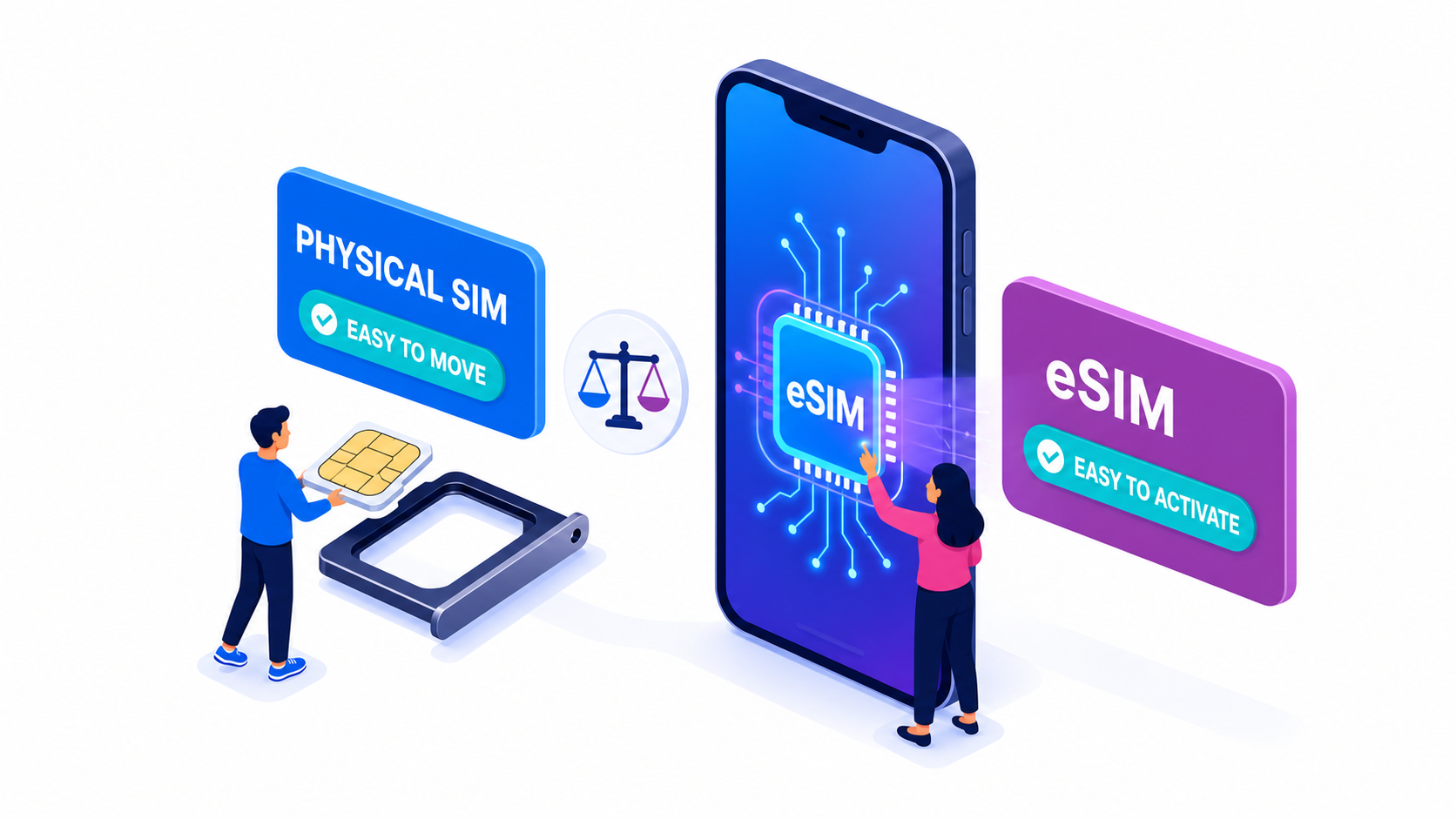
What Is a Physical SIM?
A physical SIM is the familiar removable card inserted into a tray inside your phone.
The current standard for smartphones is the nano-SIM. It stores the information needed to connect your mobile subscription to the carrier’s network.
If you change phones, you can usually remove the card and place it in another compatible device. No profile download is required.
What Is an eSIM?
An eSIM is a digital SIM built into the device.
Instead of inserting a card, you activate a cellular plan through your phone’s settings. Depending on the carrier, activation may use an app, QR code, transfer tool or manual activation details.
Apple describes eSIM as an industry-standard digital SIM that allows users to activate a cellular plan without a physical card.
eSIM vs Physical SIM: Quick Comparison
| Feature | eSIM | Physical SIM |
|---|---|---|
| Installation | Activated digitally | Inserted into the SIM tray |
| Changing phones | May require a transfer process | Move the card to another phone |
| Travel | Easy to add international plans | Requires buying and swapping cards |
| Security | Cannot be physically removed | Can be removed from a lost phone |
| Damage risk | No removable card to damage | Card or tray can be damaged |
| Compatibility | Depends on phone and carrier | Supported by most unlocked phones |
| Multiple plans | Several profiles may be stored | Limited by the number of SIM slots |
Advantages of eSIM
Easier travel
An eSIM can be especially convenient when travelling abroad. You can purchase a local or international data plan online and activate it without visiting a mobile store.
Google notes that supported phones can store multiple eSIM profiles and switch between lines or manage international plans while travelling.
Better protection against SIM removal
An eSIM cannot be physically removed from a lost or stolen phone. This may make it harder for someone to immediately disconnect the device from its mobile service.
It does not make the phone theft-proof, but it removes one simple method of disabling its cellular connection.
Multiple mobile plans
Many compatible smartphones can store several eSIM profiles. This is useful if you have:
- Separate work and personal numbers
- A temporary travel plan
- More than one mobile operator
- A backup data connection
The number of profiles that can be stored or used simultaneously depends on the device and carrier.
No SIM tray problems
There is no tiny card to lose, incorrectly insert or damage. An eSIM also eliminates the need to carry a SIM ejector tool while travelling.
Advantages of a Physical SIM
Simple transfer between phones
Moving a physical SIM to another compatible phone usually takes less than a minute. This is useful if your main phone is broken or its battery is empty.
Moving an eSIM may require Wi-Fi, carrier approval or access to the old phone.
Wider compatibility
Physical SIM cards continue to work with a very large number of phones and carriers. eSIM availability still depends on the device model, country and mobile operator.
Before relying entirely on eSIM, confirm that both your phone and carrier support it.
Visible and easy to understand
A physical card provides a clear separation between the phone and mobile subscription. Some users prefer being able to remove the SIM and know that the device is no longer connected to their mobile account.
Is eSIM Faster Than a Physical SIM?
No. An eSIM does not automatically provide faster internet or better reception.
Both technologies connect to the same carrier network. Speed and coverage depend on factors such as:
- Mobile operator
- Cellular plan
- Phone model
- Supported frequency bands
- Signal strength
- Network congestion
Switching from a physical SIM to an eSIM on the same plan should not significantly change network performance.
Can You Use Both at the Same Time?
Many modern smartphones support Dual SIM using:
- One physical SIM and one eSIM
- Two active eSIM profiles
- Two physical SIM cards
Support varies by phone, market and carrier. Google, for example, allows two active eSIM profiles on selected Pixel models when the carrier supports the feature.
You can often choose which line handles calls, messages and mobile data.
Which One Should You Choose?
Choose eSIM if you:
- Travel frequently
- Want several plans on one phone
- Prefer digital activation
- Do not want to handle physical cards
- Value protection against SIM removal
Choose a physical SIM if you:
- Frequently move your number between phones
- Use older or less common devices
- Want the widest carrier compatibility
- Prefer a simple offline transfer
- Keep a backup phone for emergencies
Before Switching to eSIM
Check the following:
- Does your phone support eSIM?
- Does your carrier offer eSIM for your plan?
- Is the phone carrier-unlocked?
- Can the eSIM be transferred to a new device?
- Will your physical SIM stop working after conversion?
- Do you need to save the activation QR code?
On some devices, converting a physical SIM to eSIM permanently deactivates the old card. Google recommends confirming that the new eSIM works before disposing of the physical SIM.
The Bottom Line
Neither option is universally better.
An eSIM is more convenient for travel, multiple plans and digital activation. A physical SIM remains easier to move between devices and offers broader compatibility.
For many users, the best solution is a smartphone that supports both. It combines the flexibility of eSIM with the simplicity of a removable card.


Recent Comments